Why Do Babies Lose Weight After Being Born Meconium
Nigh All Infants Lose Weight After They're Born. So Why Do Hospitals Focus on It And then Obsessively?

It's ridiculous how many expectations and conventions exist around childbirth and parenting. Merely over the class of writing two books about this fourth dimension of life, I've come to appreciate that there are some things you simply can not anticipate: things people don't talk about, sometimes because they are sad, sometimes uncomfortable, sometimes just apparently weird. I think we should talk virtually them—and, more than than that, we should utilise data to really empathise them. (I'1000 an economist; I honey information). Acknowledging the data can often salve a lot of the force per unit area on parents, either past reflecting experiences that feel isolating in the moment or by presenting us with a greater range of choices than we might have thought we had. In that spirit, I have a serial in Slate this week nigh how information helps illuminate childbirth and parenting's nigh underdiscussed topics.
My first child, Penelope, was born at 6 a.m. As a result, our insurance covered two nights in the hospital. On our second night—when my husband had gone home to rest and prepare the house for our return—the nurses took Penelope for some tests and returned her at 2 a.chiliad. I was sleeping. The nurse switched on the light and rolled the bassinet in; in addition to Penelope, the bassinet had a little sign: Breastfeeding Only.
"Nosotros weighed her," the nurse said, "and she's lost xi percent of her torso weight. Our limit is 10 percent, so y'all'll take to first supplementing with formula. If you don't, y'all probably won't go to take her dwelling tomorrow." I felt rising panic—non accept her home?—and also some defoliation. 10 per centum versus 11 percent? These seemed pretty similar—was that one per centum really plenty to prevent an otherwise healthy baby from coming home?
Plainly, you want your infant to thrive, and weight is an important metric. But many new parents are non expecting the tremendous focus doctors and infirmary staff place on infant weight gain or loss. If you have happily given birth to a healthy baby after a relatively uneventful commitment, the vast majority of your hospital conversations volition now revolve around the baby's feeding and weight. That might sound like a fine idea, but remember this is not a moment you are at your nearly laissez-faire. When you lot're but postpartum and trying to breastfeed for the offset time, it can be incredibly tense. It can feel like you are failing—you did such a slap-up job growing this baby inside you, and now that it's out, you are a failure. (Y'all're not!! That'southward simply how it feels.)
Here is the first thing to know: nearly all infants lose weight after birth, and those who are breastfed lose even more. The mechanisms for this are well understood. In the womb, your baby is getting nutrients and absorbing calories through the umbilical string. Once the babe is out, he has to figure out how to eat. Information technology is complicated (for both of y'all), and in the first few days, you lot won't yet have a lot of milk.
Infant weight is monitored pretty carefully in the hospital. Every 12 hours or so, they'll weigh the baby and peradventure come dorsum to report alter in weight to you. Broadly, the reasons for weight monitoring are good ones. Weight loss is not an effect in and of itself, but excessive weight loss can betoken a problem with feeding—that breastfeeding isn't working successfully, for example. This can be a clue that newborns aren't getting plenty liquid, which puts them at risk for dehydration. Dehydrated babies may and then struggle more than to feed, and you get a downward spiral. In principle this tin accept severe consequences, but these are rare.
Monitoring weight is most catching possible problems early, when you tin fix them, and constructive monitoring requires understanding how much weight newborns typically lose. Generally, nosotros desire to consider something a problem if it'south fashion exterior the normal range. If nigh babies lose x percentage of their weight, then we shouldn't worry when that happens. Zippo in biology tells you that a baby losing 10 percent of its nascency weight is a trigger for problems.
Figuring out the range of normal newborn weight loss requires data that, until recently, hasn't been that piece of cake to come past. In 2015, however, a set of authors published a really nice paper in the periodical Pediatrics that used data from hospital records on 160,000 births to graph out the weight loss among breastfed infants in the hours later birth.
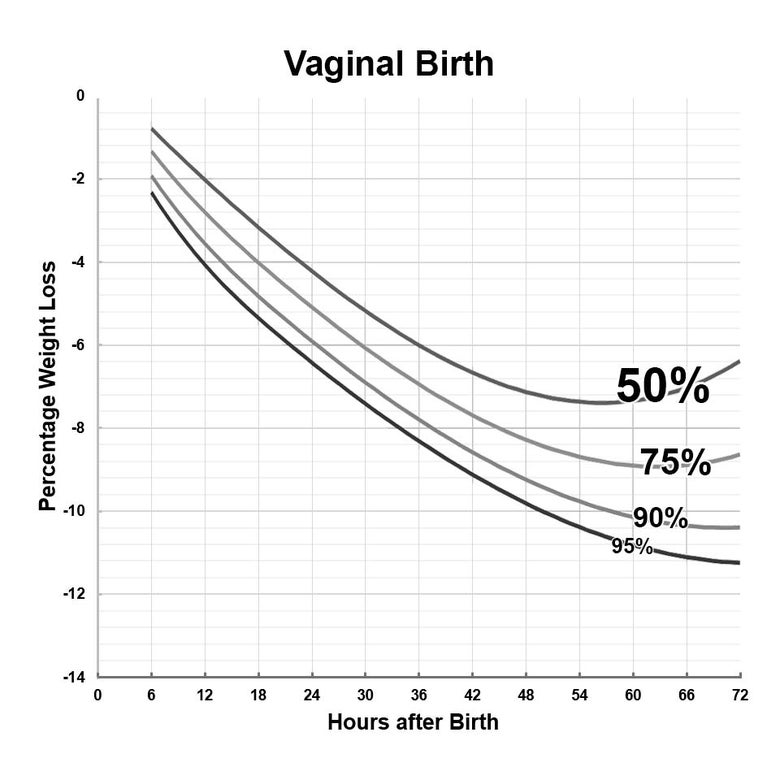
The graph beneath shows a version of this study'due south results for breastfed babies who were built-in vaginally. The horizontal axis shows infant age in hours; the vertical axis shows the percentage weight loss. The lines point how much this varies. The acme line, for example, shows the weight loss path over fourth dimension for the babe at the 50thursday percentile of weight loss.
From these figures, you tin read both the average weight loss and the range. For example, at 48 hours, the boilerplate baby born vaginally has lost 7 percent of body weight, and 5 percentage of infants have lost more 10 pct. For at least some infants, weight loss continues through 72 hours.
On average, babies built-in by caesarean department lose a bit more weight than those born vaginally, likely considering breast milk is usually a bit more delayed after a C-section. Babies who are formula-fed typically practise non lose much at all (since formula doesn't demand time to come up in).
When I had Penelope, the rule in the hospital was that if babies lose more than 10 percent of their body weight, you supplement. But you can see from the graphs that whether this is a reasonable cutoff depends tremendously on when the measurement is taken and the infant'due south particular circumstances. At 72 hours, ten pct weight loss is inside the normal range. At 12 hours, it would exist a serious outlier. The authors of this paper created a very nice website where y'all can enter the time of birth of your child, method of birth, method of feeding, birth weight, and current weight, and learn where your baby is in the distribution.
If you practice notice, equally I did, that your infant has gone over the weight loss limits, what should you do? Typically, hospitals will recommend supplementing with formula for a curt menstruation. Supplementation would rarely exist recommended before 48 or 72 hours, so information technology's useful to pay attending to your infant'southward weight before that. If she'due south losing weight chop-chop, trying to figure out why may make sense.
A last note: The major business organisation well-nigh weight loss is that it signals aridity. But this is also something you lot tin can monitor directly. If your baby is peeing with some frequency and does not have a dry tongue, there's a very good run a risk he'south not dehydrated. Conversely, if y'all practise come across these signs, supplementation may be a skilful thought even if there isn't too much weight loss.
The all-encompassing focus on weight and feeding is enough to really scare a lot of new parents—myself included. Only the data here should exist reassuring. Some pretty substantial weight loss is totally normal, even expected. Then don't be surprised, and don't panic. Even when you're trying and failing to feed an infant at 2 a.m.

Slate has relationships with various online retailers. If you buy something through our links, Slate may earn an affiliate committee. We update links when possible, but note that deals tin can expire and all prices are discipline to change. All prices were up to engagement at the time of publication.
Source: https://slate.com/human-interest/2019/04/cribsheet-newborn-infant-birth-weight.html
0 Response to "Why Do Babies Lose Weight After Being Born Meconium"
Post a Comment